La Grande Caraïbe expliquée, analysée et racontée autrement

The Greater Caribbean at the Heart of the Global Chessboard


The Greater Caribbean — a maritime and geopolitical crossroads – has always attracted the world’s major powers. From the United States to Europe, from Canada to Latin America, from Africa to the Arab world, from Asia to Russia, all of them observe, invest, trade, and seek to consolidate their positions in a region that connects the Americas, the Atlantic, and the tropical world.
The Greater Caribbean is a highly strategic – and contested – space.
The United States: The Historic and Ever-Present Power
It is impossible to talk about influence without starting with the United States. The country has considered the Caribbean its « natural sphere of influence » since the Monroe Doctrine of 1823, summed up by the famous phrase « America for the Americans. »
Washington long dictated its regional policy through trade, diplomacy, and at times force. From interventions in Cuba and Haiti to indirect control over territories such as Puerto Rico and the US Virgin Islands, American presence remains deeply embedded.
Today, the strategy has evolved: Washington is betting on economic agreements (such as the Caribbean Basin Initiative), security cooperation, and the fight against drug trafficking and irregular migration. Faced with the rise of other actors – China in particular – the United States is now attempting to reclaim an influence it considers eroded.
Canada: A Discreet but Increasingly Active Partner
Often perceived as more neutral, Canada is asserting itself more and more in the region.
A member of the Organization of American States (OAS) and an observer at the Association of Caribbean States (ACS), Ottawa supports numerous projects in the areas of governance, climate, and food security.
Its approach is shaped by cooperation and development diplomacy, notably through the Canadian International Development Agency (CIDA).
Canada is also a significant economic player, particularly in the mining and energy sectors, as well as in high-end tourism. Its influence rests on an image of reliability and stability — qualities that are often valued in a region marked by political crises.
Europe: A Historic and Postcolonial Partner
Europe remains deeply connected to the Greater Caribbean, through both history and geography.
The United Kingdom, France, and the Netherlands still exercise direct influence through their overseas territories:
- France (Guadeloupe, Martinique, French Guiana, Saint-Martin, Saint-Barthélemy)
- United Kingdom (Anguilla, Montserrat, Cayman Islands, etc.)
- Netherlands (Aruba, Curaçao, Sint Maarten)
Beyond these institutional ties, the European Union remains a major economic and political partner. The CARIFORUM–EU framework and the Cotonou Agreements have strengthened trade and regional cooperation.
Yet this influence is sometimes perceived as paternalistic – particularly in discussions around the energy transition and environmental standards imposed on Caribbean states.
Latin America: Geographic Proximity and Regional Ambition
As the Greater Caribbean’s immediate neighbour, Latin America maintains cultural, economic, and geopolitical ties with the region.
With a GDP of nearly €2.2 trillion, a Amazon rainforest that absorbs 5% of global CO₂, and a key geopolitical position in the South Atlantic, Brazil carries considerable weight.
Countries such as Mexico, Colombia, Panama, Venezuela, and Costa Rica are playing an increasingly structuring role in regional dynamics.
- Mexico is positioning itself as a bridge between North America and the Caribbean, notably through the Community of Latin American and Caribbean States (CELAC), which it helped revive.
- Colombia and Panama, active members of the Association of Caribbean States (ACS), are expanding exchanges in maritime trade, energy, and tourism.
- Venezuela, despite its internal crises, retains influence through the legacy of the Petrocaribe programme, which allowed several Caribbean states to obtain oil at preferential rates.
Beyond governments, cultural and linguistic cooperation is also deepening: university exchanges, joint environmental programmes, and cooperation on climate risk management.
The Greater Caribbean is thus becoming a space where the Latin American dream of regional integration finds expression.
China: An Indispensable Partner
For several decades, China has been patiently weaving its web across the Greater Caribbean.
Through massive investment, bilateral agreements, and high-profile construction projects, Beijing has established itself as an indispensable partner for many Caribbean governments. Modernised ports, renovated roads, brand-new stadiums, solar energy and hospital projects: Chinese influence now stretches from Jamaica to Suriname, taking in Cuba, Dominica, and Trinidad and Tobago along the way.
Under the banner of the Belt and Road Initiative, this strategy of influence is accompanied by an increasingly dense diplomatic, cultural, and educational network. Scholarships, medical equipment donations, Confucius Institutes, technical cooperation: exchanges between China and the Greater Caribbean are multiplying and reshaping regional balances.
Behind this apparently benevolent presence, however, questions remain: financial dependency, loss of economic sovereignty, debt burdens, and competition with traditional powers (the United States, the European Union, Taiwan). Debates are intense – particularly around the sustainability of this cooperation model and its real benefits for local populations.
Asia (Excluding China): Economic Players Waiting in the Wings
While China dominates media attention, other Asian countries are advancing more quietly – but steadily.
Japan is a longstanding partner, heavily involved in infrastructure project financing through the Japan International Cooperation Agency (JICA). It also supports disaster resilience and climate risk management.
South Korea is expanding its technological and energy initiatives: ICT cooperation, smart grid development, and support for the digital transition of small island economies.
India, meanwhile, leverages its Caribbean diaspora — notably in Trinidad, Guyana, and Suriname — to strengthen economic and cultural ties. New Delhi focuses on South-South cooperation, an approach seen as more equal than that of former colonial powers.
Russia: An Assertive Return Through Diplomacy and Military Cooperation
Long in retreat after the end of the Cold War, Russia has been working for the past fifteen years to regain a foothold in the Greater Caribbean.
Its approach rests on three pillars: strategic diplomacy, energy cooperation, and defence.
Moscow has deepened its ties with Cuba – a historic partner – but also with Nicaragua and Venezuela, where it has developed significant energy partnerships (notably through Rosneft and Gazprom) and marked military cooperation.
Joint exercises, the delivery of defence equipment, and official delegation visits all reflect this determination to maintain a presence in what has historically been America’s backyard.
Russia is also seeking to build political legitimacy among the Caribbean’s small island states, championing a discourse of support for multilateralism, non-interference, and national sovereignty.
Yet this strategy – viewed with caution by some nations – remains above all a diplomatic lever within the broader context of global tensions with the United States and the European Union.
Africa: A Renewed and Symbolic Presence
The ties between the Caribbean and Africa are first and foremost historical and cultural, forged in the pain of the slave trade. In recent years, however, there has been a reinvigoration of political and economic relations.
The African Union and CARICOM have held several bilateral summits to develop cooperative frameworks around culture, tourism, healthcare, and sustainable agriculture.
Countries such as Ghana, Nigeria, and Senegal are working to build bridges with the Caribbean diaspora, particularly within the contemporary pan-African movement.
This reconnection, still largely symbolic, carries enormous potential: educational exchanges, heritage tourism, cross-investment, and diplomatic solidarity on major international issues – climate, debt, global justice.
The Arab World: A New Strategic and Financial Interest
Over the past decade, Gulf states – notably the United Arab Emirates, Qatar, and Saudi Arabia – have been stepping up their diplomatic and economic initiatives toward the Greater Caribbean.
Their aim: to diversify partnerships, invest in sustainable tourism, renewable energy, and port infrastructure, while consolidating their image as globally engaged powers open to the Global South.
The UAE has hosted several Caribbean delegations at international forums, including the World Government Summit and COP28 in Dubai, deepening discussions on climate resilience and green finance.
Qatar is exploring cooperation in sport, culture, and training.
Saudi Arabia, through its sovereign wealth fund (the Public Investment Fund), is eyeing partnerships in clean energy and maritime logistics.
Beyond the economic dimension, this presence reflects a desire for South-South rapprochement between tropical regions facing shared challenges: economic diversification, rising sea levels, energy dependency, and the need for innovation.
A Region at the Heart of a New Global Chessboard
Today, the Greater Caribbean finds itself at the intersection of trade routes, energy ambitions, and diplomatic rivalries.
Between Washington and Brussels, between Ottawa and Seoul, between Accra, Mexico City, and Dubai, the region is becoming a space of experimentation and soft competition — but above all, a terrain where Caribbean states are seeking to assert their sovereignty, skilfully navigating these overlapping influences.
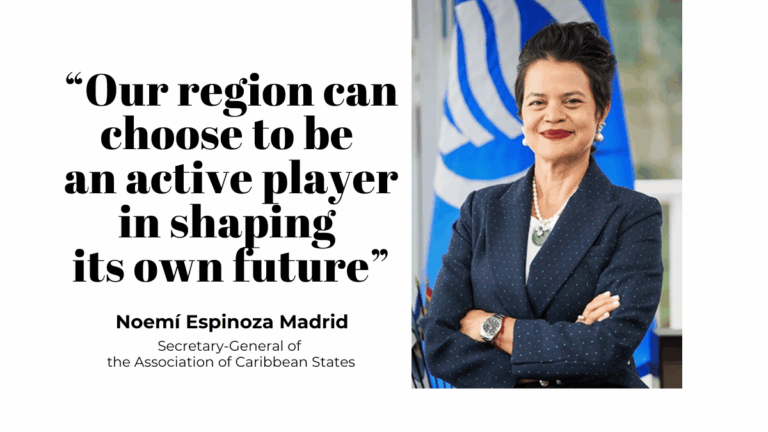
The Caribbean no longer wants to be merely a zone of influence. It aspires to become a fully-fledged actor, capable of defining its own priorities and making its voice heard on the world stage.