La Grande Caraïbe expliquée, analysée et racontée autrement

The Greater Caribbean: What If Sargassum Became a Food Ingredient? American Researchers Think It Could

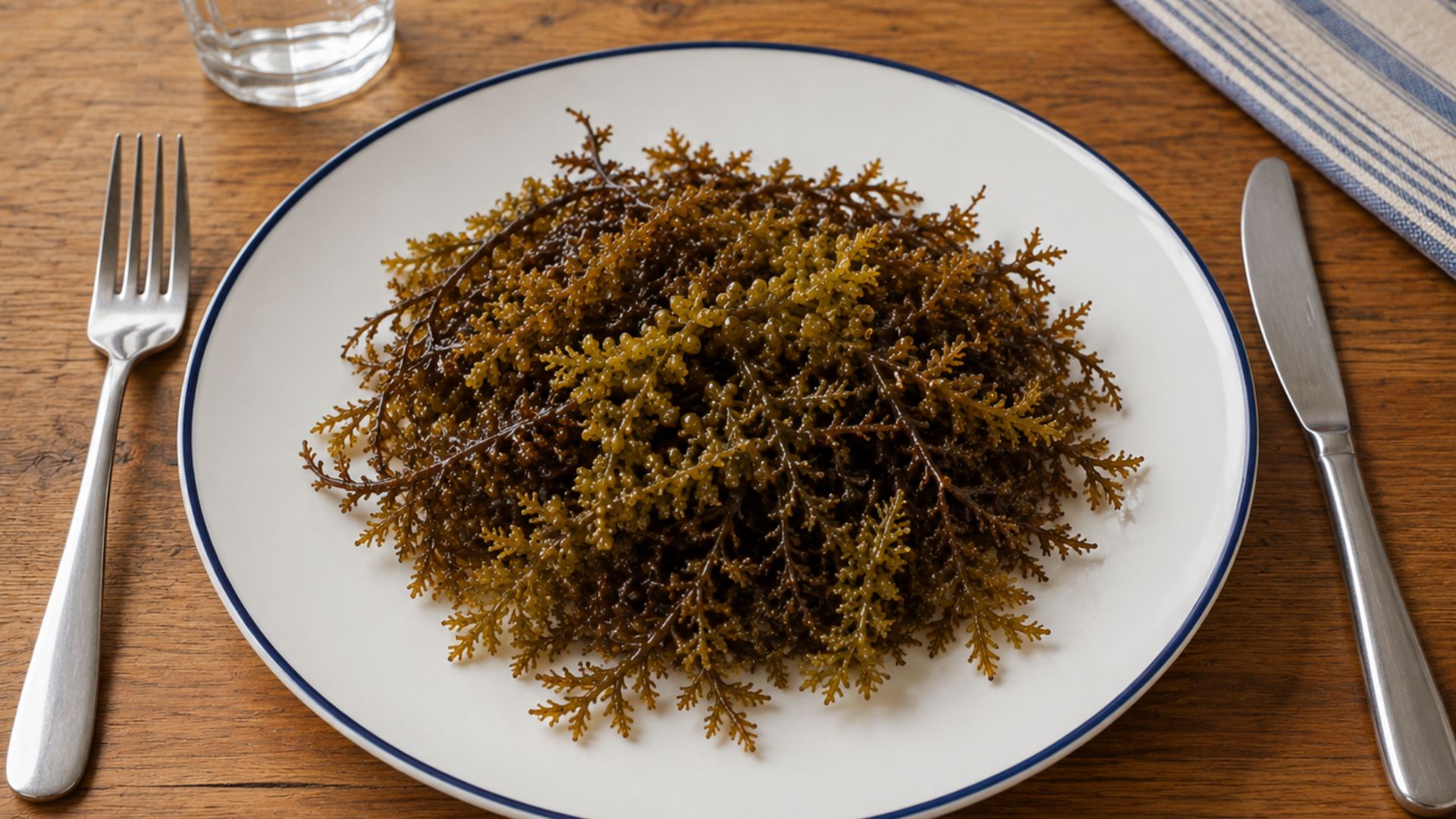
A study published in February 2026 in the scientific journal Food Hydrocolloids opens an unexpected avenue for turning one of the Greater Caribbean’s most significant marine nuisances into something useful: transforming pelagic sargassum into high-quality food-grade alginate.
Conducted by researchers from three Florida universities — Florida State University, Florida Atlantic University, and Florida International University — this research proposes not to fight sargassum, but to make use of it.
A Growing Scourge
The figures are staggering. In 2026, some 10 million metric tonnes of sargassum are already floating across the Atlantic, washing up on Caribbean and Floridian coastlines. Since 2011, these accumulations of Sargassum natans and S. fluitans have intensified, spreading across the Great Atlantic Sargassum Belt, from the Caribbean Sea and the Gulf of Mexico to the West African coast.
On beaches, the toll is heavy: economic damage to tourism, public health issues linked to hydrogen sulphide emissions, and collection costs that mount season after season.
From Nuisance to Raw Material: The Alginate Bet
At the heart of the research lies a molecule well known to the food industry: sodium alginate. This polysaccharide — present at up to 21% of dry weight in Sargassum, according to regional composition studies — is already used in ice cream, dairy products, and salad dressings for its thickening, gelling, and emulsifying properties.
The researchers’ idea: to optimise the extraction of this alginate from pelagic sargassum, a source that had until now been overlooked.
The result: under optimised extraction conditions (80°C, 5 hours of treatment, sodium carbonate concentration of 0.3 M), raw alginate yield reaches 44.2% of dry weight.
Three Pre-treatments Tested: Pressure Wins Out
The originality of the study lies in its systematic comparison of three pre-treatment techniques applied before extraction — never before tested together on pelagic sargassum, according to the authors. Autoclaving (thermal), high-pressure processing or HPP (non-thermal), and sonication (non-thermal) each produced markedly different results.
Autoclaving, which subjects the biomass to 121°C under pressure, proved the most destructive: it reduces the molecular weight of alginate to under 15 kDa, compared to 136 kDa for the untreated control, collapses viscosity to 3.23 mPa·s, and lowers gel strength to 77 g, versus 175 g for the control. Alginate degraded in this way loses most of its functional properties and becomes poorly suited to food applications.
Sonication for 10 minutes, by contrast, remarkably preserves molecular integrity — with a molecular weight of 83 kDa — and produces the highest gel strength among the treated samples, between 144 and 174 g. This is the technique of choice for applications requiring texture: gels, encapsulations, and structured systems.
HPP at 400 MPa — the equivalent, according to the researchers, of placing ten elephants on a single surface — produces the highest emulsification index: 17.2%, compared to 5–6% for autoclaving. This result is thought to stem from a partial reduction in polymer chain length, which increases their mobility and facilitates redistribution at the oil-water interface during emulsification. This technique is therefore the most suitable for dressings, beverages, and emulsions.
Food Safety: A Non-Negotiable Prerequisite
The question of contaminants is addressed seriously. Sargassum can accumulate heavy metals — arsenic, lead, cadmium — which rules out any direct consumption of raw biomass. The researchers measured a cadmium level of 0.49 mg/kg dry weight in their oceanic sample, within the Caribbean regional range (0.1 to 1.4 mg/kg), and a lead level below the detection threshold of the instrument used. These levels, when compared against Codex Alimentarius limits (0.1 to 2 mg/kg for cadmium, 0.01 to 2.5 mg/kg for lead), remain in low ranges. Crucially, the successive purification steps — acid washing, alginic acid precipitation, and conversion to sodium alginate — are expected to further significantly reduce metallic residues in the final product.
The chemical structure of the alginate (its backbone, its composition in guluronic and mannuronic acids, and its M/G ratio of between 0.25 and 0.35) remained intact regardless of the pre-treatment applied. Pre-treatments modify chain length — not chemical composition.
A Real Horizon, but Still a Distant One
The researchers themselves situate their work at the second of three stages they have defined: analysing the material, extracting useful compounds, and then developing finished products. This third phase — creating ice cream or other sargassum alginate-based foods — requires further funding, testing, and regulatory approvals. The project is supported by the National Institute of Food and Agriculture at the US Department of Agriculture (USDA).
This study clearly signals a paradigm shift in how sargassum is approached: no longer solely as a problem to be managed, but as a resource to be valorised.
For the countries and territories of the Caribbean that have been bearing the brunt of brown tides for over a decade, this repositioning — from waste to ingredient — deserves attention.