La Grande Caraïbe expliquée, analysée et racontée autrement

Noemí Espinoza Madrid, Secretary-General of the Association of Caribbean States: “Our region can choose to be an active player in shaping its own future”

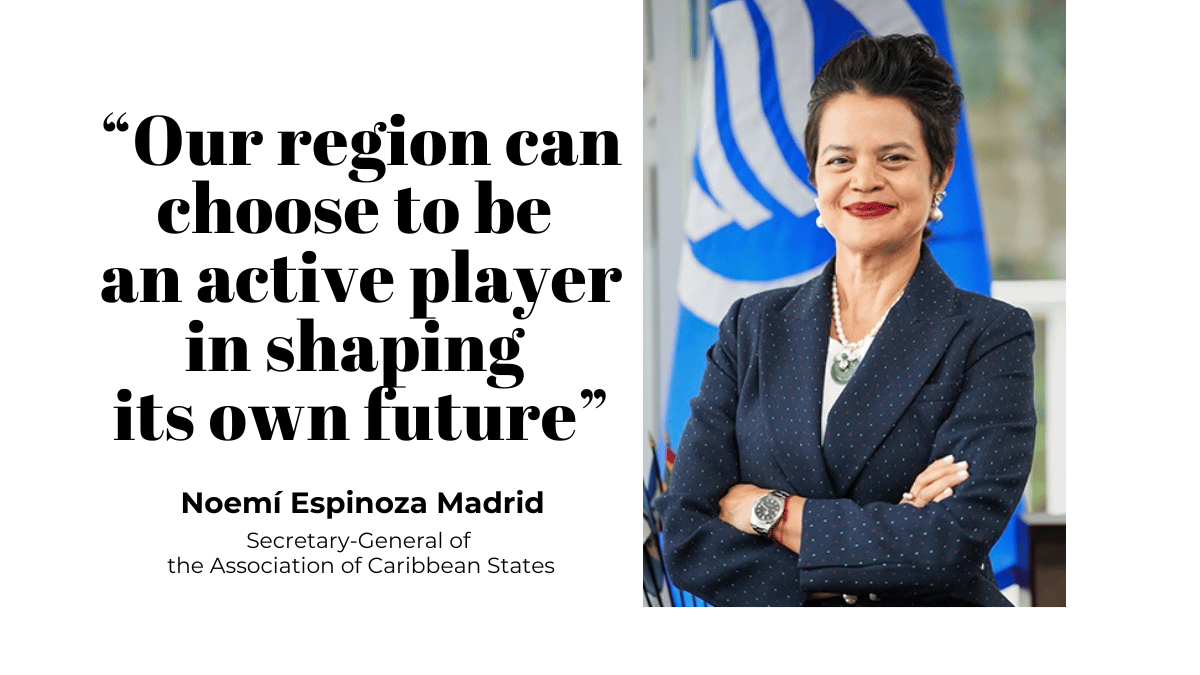
Over the course of my career, I have conducted a great many interviews that have left a lasting impression on me. My conversations with leaders of Caribbean regional institutions are among them. Indeed, hearing their views first-hand on the challenges facing the Greater Caribbean is, of course, exhilarating.
When I was offered the opportunity to interview Noemí Espinoza Madrid, Secretary-General of the Association of Caribbean States (ACS), I accepted at once. I have followed her work since she took office on 1 January 2025. It is worth noting that she is the eighth Secretary-General and the first Honduran to lead the organisation.
Moreover, I have been writing about the ACS for years, as it is one of the major regional organisations, with 25 Member States and 10 Associate Members. Every territory bordering the Caribbean Sea has a seat at its table!
In the course of this interview, Noemí Espinoza Madrid reflected on her career, the “Greater Caribbean 2035” Strategic Plan (to which I have already devoted a blog post and an episode of my podcast), the situation in Haiti and the place of the French territories.
Thirty years of diplomacy
What in your career prepared you to lead the ACS?
I have been a career diplomat in the service of the Honduran government since 1996, that is, for 30 years. My path has taken many turns. I began in the foreign service, at a consulate in New York. I arrived there very young, for what was meant to be a single year. That year turned into 27, with a brief two-year interruption. After the consulate, I soon joined the Mission of Honduras to the United Nations, and then worked for the UN itself, in one of its development agencies.
I have worked within the development and human rights architecture at the global, regional and national levels. This experience gave me a very sound understanding of development and human rights needs at every level, particularly in Latin America and the Caribbean. The ACS, as it happens, has two arms: the Secretariat, a political arm very close to the work of a diplomat, and cooperation, which falls within the field of development. My work in regional and national offices prepared me to steer the ACS’s cooperation efforts.
Which of these two arms do you prefer, the political one or the cooperation one?
That is a big question. To be perfectly frank, I prefer the political side. As a diplomat, it is where I have worked most. Negotiating a text or a specific outcome is an exercise in which I feel very much at ease. It nonetheless remains essential for me to understand the other side in order to work with the colleagues responsible for it. Nevertheless, my preference lies with intergovernmental work.
You have worked on disaster risk reduction. How do you apply this expertise to our region?
I have worked on a great many subjects, including disaster risk reduction. In my career before the ACS, most of my work concerned climate change in the broad sense and the major climate agreements. I was at the UN for the Paris Agreement and for everything that followed. I was even there at the time of its forerunner, the Kyoto Protocol. Disaster risk reduction falls within this broader climate framework.
I hope that no one still disputes the reality of climate change, to which our region is particularly vulnerable.
Taking it seriously and acting upon it is fundamental to our well-being. However, not everything depends on us: multilateralism requires the entire international community to play its part. We in the Greater Caribbean did little or nothing to create this crisis. Yet we are the ones bearing its heaviest consequences.
An organisation in need of revitalisation
What did you find when you arrived at the Secretariat, and what did you decide to change?
I arrived in January 2025 at an organisation that was 30 years old, almost as old as my career. I found an organisation with a remarkable mandate and an outstanding group of people working for it, both in the Secretariat and within the Member States. However, the world of 2025 bore little resemblance to that of 1994, the year the ACS was founded.
I therefore inherited a mandate to revitalise the organisation and to draw up a strategic plan. The organisation had never had one. My first year was thus largely devoted to it. We proceeded in a highly consultative manner, holding meetings that brought together all our Member States, as well as experts from the United Nations, academia and other fields. I drew extensively on my UN network. It all began with a high-level meeting in Trinidad and Tobago, because I believe that no one holds the absolute truth. The Member States know the priorities; the experts bring their perspective.
I first changed the strategic direction of the organisation in order to modernise it. The priorities remain broadly the same, now conceived for 2026 and beyond. I also transformed much of our internal functioning, because for the Secretariat to carry this new vision forward, we had to change the way we work: new opportunities to mobilise resources, the possibility of working with the private sector, and an organisational structure suited to our ambitions. This has been a year of major change.
Did the Secretariat staff embrace these changes?
Some people resist change; others welcome it with enthusiasm. The entire Secretariat, 100 per cent of it, took part in these meetings from the outset. Working groups were organised with the consultants responsible for drafting the plan. I made this clear from the moment I arrived: we will build this together, because those who truly know how things work are those who already work here.
There is always a human resistance to change. For my part, I am very open to it. Change is one of the few certainties in this life.
Focus on the “Greater Caribbean 2035” Plan
The Strategic Plan “Greater Caribbean 2035 – A Shared Horizon: From Our Common Sea towards Sustainable Development and Collective Well-being” starts from an observation: a region “in danger of being left behind”. Left behind by whom? And has this diagnosis become irreversible?
Let me say it at the outset: nothing is irreversible, and the region has not yet been left behind. We must nonetheless be aware of the world in which we live. Drawing up the strategic plan at the start of my term obliged me to look at where we stand and where we are heading. Today’s world is experiencing geopolitical tensions and interlocking crises: the climate crisis, wars and migration, which are hitting many people in our region hard.
The risk of being left behind exists, first, if we continue to do things as we have always done them. Second, I observe a more pronounced trend in 2026: the countries of the Greater Caribbean are being drawn into the game of geopolitical tensions and are compromising their own interests under the influence of other forces. That is a serious mistake. A recent report by the Economic Commission for Latin America and the Caribbean (ECLAC) addresses these ruptures in globalisation. Its central idea: we can choose to be active players in shaping our future, or be subjected to what someone else thinks we should do.
The plan states it clearly: we have the capacity to act collectively as the Greater Caribbean. That does not mean agreeing on everything. We will not.
On what unites us, however (protecting our climate, protecting our peoples, negotiating with everyone, forging practical alliances without aligning ourselves with a single camp), we need to be more astute. We can move closer to one major power for trade, work with another because it will help us protect the Caribbean Sea, and with a third on something else. We do not do this enough, and we are in danger if we remain blind to part of the equation instead of acting in our own interest.
There are many formulas: functional cooperation, pragmatic multilateralism. CELAC, I believe, speaks of strategic non-alignment. Once again, we do not have to agree. One may be on the left or on the right. Nevertheless, we have a responsibility, and the ACS Secretariat has the responsibility to protect the Caribbean Sea and the peoples who live along its shores.
You are calling for the Caribbean Sea to be recognised as a “special area in the context of sustainable development”. How can the ACS succeed on this front?
This designation was negotiated at the United Nations General Assembly. There is a resolution, adopted some time ago, that recognises the Caribbean Sea as a special area in the context of sustainable development. This is a significant achievement. We are not the main contributors to climate change, and yet we bear its effects. To meet these challenges, we must work with the Europeans, the United States, China, other Asian countries and African countries.
Being recognised as a special area makes it easier to access donor funding and to work collectively, because the objective is clear: to protect a special area in the context of sustainable development.
The subject comes before the General Assembly every two years, and it will be considered this year. We have already submitted the draft report, which is then published by the UN Secretary-General. My ambition is to make this recognition somewhat more concrete, to spell out what it means. The ACS is the only organisation that covers every country or territory bordering the Caribbean Sea, all of which are members or associate members. It is therefore the ideal mechanism for advancing issues related to this sea.
Take sargassum, a subject on which I know Guadeloupe is working extensively. As I often say, sargassum does not know whether it is in Guadeloupe, Cancún or Trinidad and Tobago. Who is better placed than the ACS to provide solutions, working with others, of course? That is the whole point of the special area: a political instrument that helps us work together.
Complementarity rather than competition
CARICOM, CELAC and the OECS already exist. What sets the ACS apart from these organisations? Do they all do the same thing?
That is a very important question, because many people wonder what purpose all these organisations serve. The issues relating to the well-being and dignity of the peoples of the Greater Caribbean are so vast that no single organisation needs to occupy the field alone. There are also differences.
- The Caribbean Community (CARICOM) is an integration mechanism that works on a common market and on how its countries can come together. All CARICOM countries are members of the ACS.
- The Organisation of Eastern Caribbean States is similar, focusing on the countries of the Eastern Caribbean.
- The Community of Latin American and Caribbean States (CELAC) is more of a political body.
- The ACS is fortunate not to have to deal with these issues, which are highly complicated today. It is even difficult to agree on whether or not an area is a zone of peace.
I have always insisted on complementarity and non-duplication.
A concrete example: since I became Secretary-General, we have begun working with Haiti. Haiti is a member of the ACS, CARICOM, the Organization of American States (OAS) and other organisations. At first, some Member States and some leaders of these organisations asked me what we were going to do in Haiti, since everyone was already working there. I replied that Haiti is a Member State of the ACS, that it is suffering profoundly, and that it would be inexcusable to do nothing. If they could assure me that the situation in Haiti had been resolved, we would withdraw. That is not the case.
I spoke to the leaders of all these organisations to tell them that I did not wish to duplicate efforts. The world is complex enough, and Haiti needs us. This is not the time for institutional self-promotion. The problem must truly be solved. We also make sure that Haiti leads what we undertake. We have set up an ad hoc working group chaired by Haiti and Mexico, dedicated to humanitarian and development issues.
I travelled to Haiti personally, and we asked the Haitian authorities what the ACS could do. We are currently working on an online knowledge platform, a need expressed by all, including the United Nations team in Haiti. It will bring together information from all the actors present, including non-governmental organisations such as the Red Cross. That is our contribution. There is no need to compete: there is enough to be done for all of us to work together.
Guadeloupe and Martinique: a central role expected
Guadeloupe and Martinique are Associate Members. Guadeloupe is engaged in disaster risk reduction, Martinique in tourism. What role do you expect the French territories, including French Guiana and Saint Martin, to play in implementing the 2035 Plan and within the ACS?
I of course welcome the participation of all our Associate Members, including Guadeloupe and Martinique. I had the pleasure of visiting Martinique a few months ago for a conference on security. I have not yet been to Guadeloupe. Nevertheless, we carry out a great deal of work with Guadeloupe, Martinique and the other territories. The Associate Members provide a valuable link with our other partners.
You are in the Caribbean Sea; you are part of the ACS. Sargassum, tourism, disasters… A hurricane will not spare one part of the Caribbean! We must all be present, and therein lies the distinctiveness of the ACS.
Your contribution is fundamental. I am very pleased, and pleasantly surprised, by Guadeloupe’s contribution. Guadeloupe is a pioneer on sargassum; you have your own system in place and you have achieved a great deal. We can learn from what you are doing, and so can others. The same applies to Martinique in the field of tourism. Your link with France also opens the doors of the European Union to you. I travelled to Paris, where I met the officials responsible for the French overseas territories. These open doors are useful to us, because these matters are of direct interest to them. I can hold meetings in other countries that have no territories in the Caribbean; however, it is not the same as with a country that is present in the region.
I expect Guadeloupe, Martinique and the other territories to play a leading, direct and central role in implementing our strategic plan.
Does their membership of the European Union represent leverage or a constraint?
It is a good thing: leverage. I firmly believe in partnerships with other countries and other regions. The European Union has a great deal to offer, and a direct interest in the well-being of the Caribbean, which can only help us. I have had very good meetings in Paris, with the French Ambassador to Trinidad and Tobago, as well as with other European counterparts and with the European Union itself. On sargassum, precisely, I will be travelling to Mexico for the sargassum conference, organised in part by Global Gateway, a European Union mechanism.
In conclusion, I truly believe that we must focus on the many issues that can benefit us. Yes, we are living in difficult times. All the more reason to work together, to be strategic and to make progress wherever possible. There is no shortage of issues. Let us be astute. With the European Union, we may not need to agree on everything, yet we can agree that sargassum is a problem we want to solve.
My conclusion
I greatly enjoyed this interview, because Noemí Espinoza Madrid did not sidestep my questions and even put her finger on a sore point: the disagreements among Caribbeans that expose our region to threats from all sides. The ACS has a plan and, in the person of its Secretary-General, a strong voice. I will certainly request another interview in a few months’ time to review progress on the various areas of work discussed.