La Grande Caraïbe expliquée, analysée et racontée autrement

Did You Know? Belize and Guatemala Have Been Disputing a Border for Two Centuries

One of the oldest territorial disputes on the American continent may be on the verge of resolution — before an international tribunal.
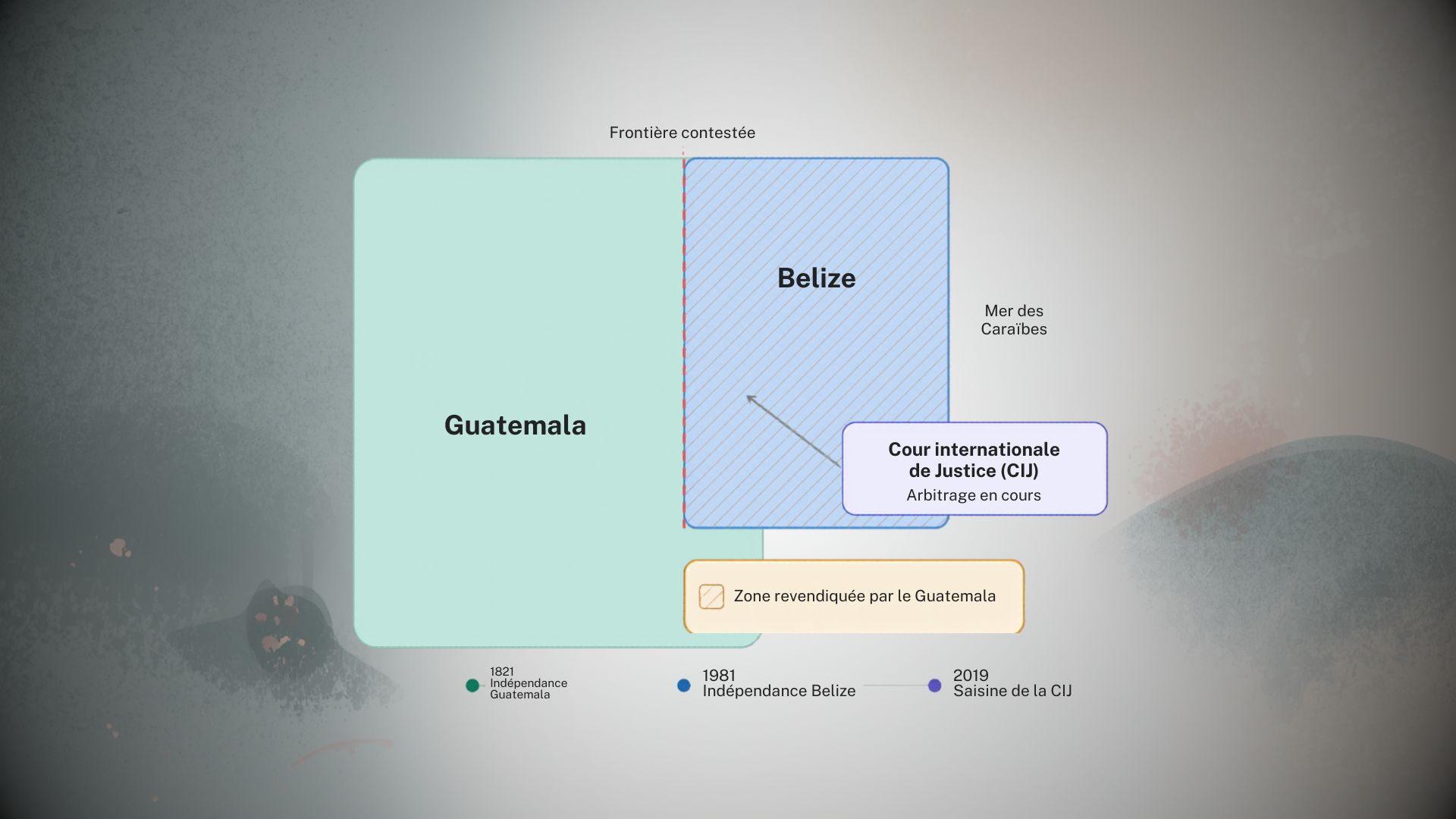
Imagine two neighbours squabbling over a fence since 1821. That is roughly what has been happening between Guatemala and Belize — in geopolitical form. Since independence, Guatemala has never truly accepted the existence of its neighbour to the east, a product of British colonisation, and has long claimed a large portion of its territory. A dispute as old as the states themselves, passed down from generation to generation like an awkward inheritance.
A Story of Maps and Colonies
It all begins well before either country’s independence. From the 17th century onward, British settlers established themselves along the coast of what would become Belize — then known as British Honduras — to exploit precious timber, particularly mahogany. Spain, which controlled the region, tolerated this presence with difficulty but never managed to eliminate it entirely.
When Guatemala gained independence in 1821, it inherited — in its own view — all territories that had fallen under the former Royal Audiencia of Guatemala, a Spanish colonial institution. British Honduras, it argued, was among them. The problem: the British saw things differently, and continued to administer the territory until Belize proclaimed independence on 21 September 1981.
Guatemala initially refused to recognise the new state, maintaining its claim over virtually the entire Belizean territory — around 12,000 km², roughly half the country. The situation was all the more fraught given that Belize, a small country of fewer than 400,000 people, found itself squeezed between the Caribbean Sea and a far more powerful neighbour.
Decades of Tension, Then Dialogue
For decades, the border was a line of friction. Guatemalan soldiers and British forces stationed in Belize faced one another across it. Skirmishes broke out, diplomatic incidents multiplied. Residents of border areas lived in permanent uncertainty about the status of their land.
It was not until 1991 that Guatemala officially recognised Belizean independence — a considerable first step. Recognising a state’s existence, however, does not mean renouncing territorial claims. Guatemala maintained its position, and bilateral negotiations stalled for years to come.
The Organisation of American States (OAS) stepped in as mediator, establishing a demilitarised adjacency zone on both sides of the border and facilitating technical discussions. The conflict remained peaceful, but politically, the issue remained a live wire in both countries — particularly in Guatemala, where the Belize question is taught in schools and endures as a symbol of lost territory.
2019: An Unprecedented Moment in Diplomatic History
In 2019, something unprecedented occurred. The two countries agreed to submit their dispute to the International Court of Justice — and decided to consult their own citizens before doing so. Popular referendums were held simultaneously on both sides of the border.
Guatemalans approved the move by more than 95%. Belizeans, with more measured but clear enthusiasm, also said yes. It was the first time in the history of international law that a territorial dispute was referred to the ICJ following two simultaneous popular votes — a remarkable precedent, widely praised by the international community.
The proceedings are now underway before the ICJ, based in The Hague. Both parties have submitted their memorials and presented their historical, legal, and geographic arguments. The final ruling, expected in the coming years, will be binding on both states — a commitment they have both made.
One thing to remember: for the first time in two centuries, the border between Belize and Guatemala could be definitively drawn — not by force or imposed treaties, but by an international legal judgment freely accepted by both peoples.
A Model for the World?
What makes this case so fascinating is not just its age or the complexity of its legal arguments. It is the method chosen: two small countries, without military resources comparable to major powers, decided to trust in law rather than force — and to involve their citizens in that decision.
In a world where border conflicts too often spiral into armed confrontation, the Belize–Guatemala case offers a concrete and encouraging alternative.